
Penis Cancer
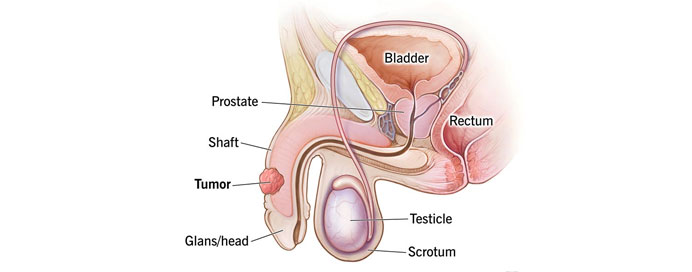
Penile cancer is a rare type of cancer that develops on the skin or in the tissues of the penis. It primarily affects the glans (tip) or the foreskin, but can also involve the shaft. Most penile cancers are squamous cell carcinomas, meaning they arise from the flat cells that cover the penis. It is more commonly seen in men over the age of 50 but can occur at younger ages, especially in those with risk factors.
Risk Factors
- Human Papillomavirus (HPV) infection – particularly HPV types 16 and 18.
- Poor hygiene – especially in uncircumcised men.
- Phimosis – inability to retract the foreskin.
- Smoking – increases risk due to carcinogenic exposure.
- Chronic inflammation – due to conditions like balanitis or lichen sclerosus.
- Age and immunosuppression – older men and those with weakened immunity are at higher risk.
Symptoms
- A growth, ulcer, or sore on the penis that does not heal.
- Redness, swelling, or thickening of the skin on the penis.
- Foul-smelling discharge from the lesion.
- Bleeding from the affected area.
- Pain in advanced cases.
- Enlarged lymph nodes in the groin (may indicate spread).
Diagnosis
- Physical examination – evaluating the lesion and lymph nodes.
- Biopsy – confirms malignancy and identifies histological type.
- Imaging studies – MRI, CT scan, or ultrasound to assess local invasion or metastasis.
- Lymph node evaluation – fine-needle aspiration or sentinel node biopsy if nodes are enlarged.